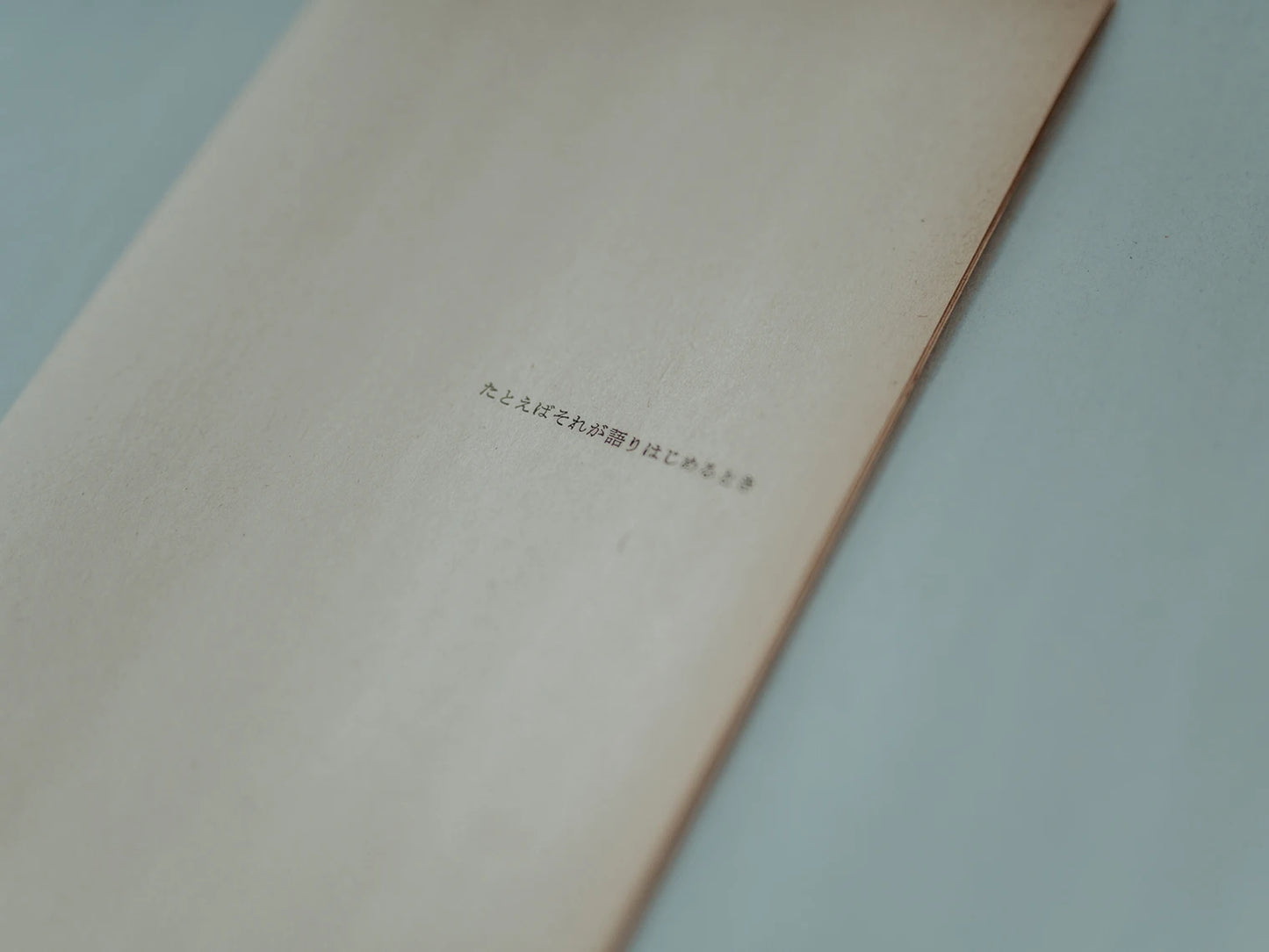
As it begins to speak
As it begins to speak
Price:Regular price
6,600 JPY
Regular price
Sale price
6,600 JPY
Unit price
per
Couldn't load pickup availability

Process notes: To see or to read, the making of a book in between
- Design:
- Takeo Chiboshi(Necktie Design Office)
- Size:
-
Letterpress Edition w128.5 × h364
On-demand Print Edition w128 × h207
Statement mil / yom w128 × h182
Package w130 × h368
- Material:
- Paper
- Product:
- Made in Japan

How do these differences in form affect the way we see and read text? Are we reading words, or are we seeing them? Or perhaps these two acts cannot be clearly separated at all.

The set includes four components: Letterpress printing, on-demand printing, a website, and the statement mil / yom. Limited edition of 100 copies, each individually numbered.

Letterpress edition. A piece shaped by hand, chance, and a certain degree of ambiguity. Each page is printed with metal type on antique paper. 12 page hand-bound booklet.


On-demand print edition. Standardization, mass production, speed. A symbol of contemporary printing efficiency. On-demand printing breaks the limitation of offset runs, making high-quality small-batch production possible. Paper and dimensions are specified online, and the printed work is delivered within a week. 12 page saddle-stitched booklet, based on the golden ratio.


Website edition. Data, convenience, fragility. The fastest medium of all. Once uploaded, it becomes instantly accessible worldwide. Text can be copied, translated, and corrected without delay. Yet as a support for language, it remains fragile—content can be removed quietly, and access may suddenly disappear.

Statement mil / yom.
A booklet of reflections on seeing and reading. It serves as a companion volume to As It Begins to Speak.
The slash in the title originally signifies or. In recent years, however, it has increasingly come to suggest and as well. The title draws on this ambiguity, occupying the space between the two meanings.


The top edge is left uncut. To read it, you open the pages by cutting the top edge with a paper knife or similar tool. The work is intentionally left in a state of becoming—a book that is not yet fully bound, retaining a sense of something still in formation. The pages are not given as something already open; instead, they slowly take the shape of a book through the reader’s hands. A small gesture of cutting the pages. Yet this slight act makes reading feel more physical, more embodied. 24 pages, scram-bound and wrapped with string.